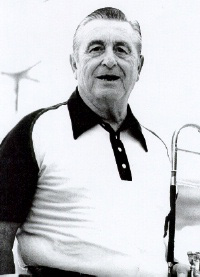
Abram “Abe” Lincoln was born in Lancaster, PA on
March 29, 1907.
At the age of 5, Abe began playing cornet. Under the direction of his
father, Abe would practice scales every day and had to play them correctly
each night before being permitted to go to bed. Not only would Abe have to
play the scales correctly, he had to name the notes, name the fingering and
the value of the notes. Soon, Abe was practicing marches, polkas—anything
his father could get his hands on for him to play. However, contrary to his
father's wishes, Abe would frequently ad lib around the melody. It was at
this point that Abe's talent for improvisation began to emerge.
In 1926, Abe replaced Tommy Dorsey in the California Ramblers. Also
during the '20s, he worked with Arthur Lange and Ace Brigode. After stints
with Roger Wolfe Kahn and Paul Whiteman, Abe joined Ozzie Nelson's band in
1934 and stayed for five years. In 1939 he moved to Hollywood and spent
many years as a studio musician.
With the onset of the Dixieland revival in the 1940s, Abe worked and
recorded with many small jazz bands. In the 1960s, he was mainly active as
a freelancer, although he spent a brief period with the Village Stompers and
with Wild Bill Davison in early 1967. In 1976, Abe was featured at the
annual Sacramento Jazz Jubilee.
Some of the more memorable recordings of Abe's playing:
Coast Concert led by Bobby Hackett, where Abe trades
“fours” with Jack Teagarden; with Matty Matlock's
Paducah Patrol records on the Warner Brothers label, and with the
Rampart Street Paraders. Abe also appears on the soundtrack of the
Woody Woodpecker cartoon series.
On August 2, 1999, the Jim Cullum Jazz Band paid a visit to Abe at his
home and played a personal concert for him in his living room. The party
was organized by Abe Jr. and Jim Cullum Jazz Band trombonist Mike Pittsley.
Abe Lincoln passed away on June 8, 2000 at the age of 93.
The following is contributed by Mike Pittsley:
“It is with great personal sadness that I note the passing of Abram
“Abe” Lincoln, a true legend and vastly underrated giant of the
jazz trombone. Abe's hot, fiery style and instantly identifiable sound make
it impossible to mistake him for any other trombonist. He was my primary
influence and I've always tried to incorporate the same degree of energy and
excitement in my own playing.
“I first heard Abe on an album loaned to me by my high school band
director. He wanted to expose me to the playing of another jazz trombone
legend, Jack Teagarden. However, there was another trombonist on this album
whose playing caught my attention even more. The album was Coast Concert
and the other trombonist was Abe Lincoln. I was truly knocked out by his
aggressive, no-holds-barred approach. Although I certainly took note of Jack
Teagarden's playing, I found myself even more intrigued and inspired by
Abe Lincoln. While Jack's playing was flawless, Abe was “pushing the
envelope” and playing with true passion. As I began to grow and develop
as a jazz trombonist, I became increasingly captivated by the excitement he
so easily projected in his playing.
“In 1995 I had the great honor of finally getting to meet Abe. While
doing some research for an upcoming Riverwalk program featuring the history
of the jazz trombone, I was invited to attend Abe's 88th birthday party at
his home in Southern California. Although Abe had long since retired from
the music business, he still played his horn for close friends and relatives
at his birthday parties. I brought my horn along and got to play several
tunes with him. I never dreamed I would ever get to meet Abe Lincoln, much
less get to play with him. It was a dream come true for me. It was exciting
for me to watch Abe as he played. He had a youthful, almost mischievous,
twinkle in his eye that gave a clue as to the source of his energy and
passion for the music.
“The opportunity to meet my hero, and to learn from him personally is
a blessing I will always cherish. Abe and I became good friends and he
unselfishly shared his knowledge and experience with me. I simply cannot
express the degree to which I have since grown as a player. I feel like I
have lost a member of my own family.”
Abe and His Fans
by Mike Pittsley
In the process of putting together this website, I had the opportunity to
pore over numerous fan letters that Abe received throughout his career. It
came as no surprise that Abe's musical influence ran wide and deep.
One fan letter in particular caught my attention and I felt that it needed
to be shared.
The following is a fan letter from a young aspiring trombonist by the name
of Steve Dillon, dated November 15, 1975. Steve was 14 years old at the
time and wrote Abe to ask him for his autograph.
Fan letter from Steve Dillon, November 15, 1975
Fans never received a reply to their letters; however, Abe treasured them
all. His fan mail was always within arm's reach and he could produce his fan
mail on a moment's notice.
Although Abe was a musical extrovert in every respect, he tended to be a
very private person. Unfortunately, this was sometimes misinterpreted by
fans and jazz writers.
Abe very seldom granted formal interviews. Nonetheless, Abe loved people
and in more informal settings, Abe was always delighted to share his knowledge
and the fascinating experiences of his long and colorful career.
My personal experience with Abe as both a mentor and as a good friend was
that of a warm, sincere, unselfish and caring man who loved life.
Steve Dillon went on to make music a career and now has become one of
the most well-known and respected musical instrument retailers on the East
Coast.